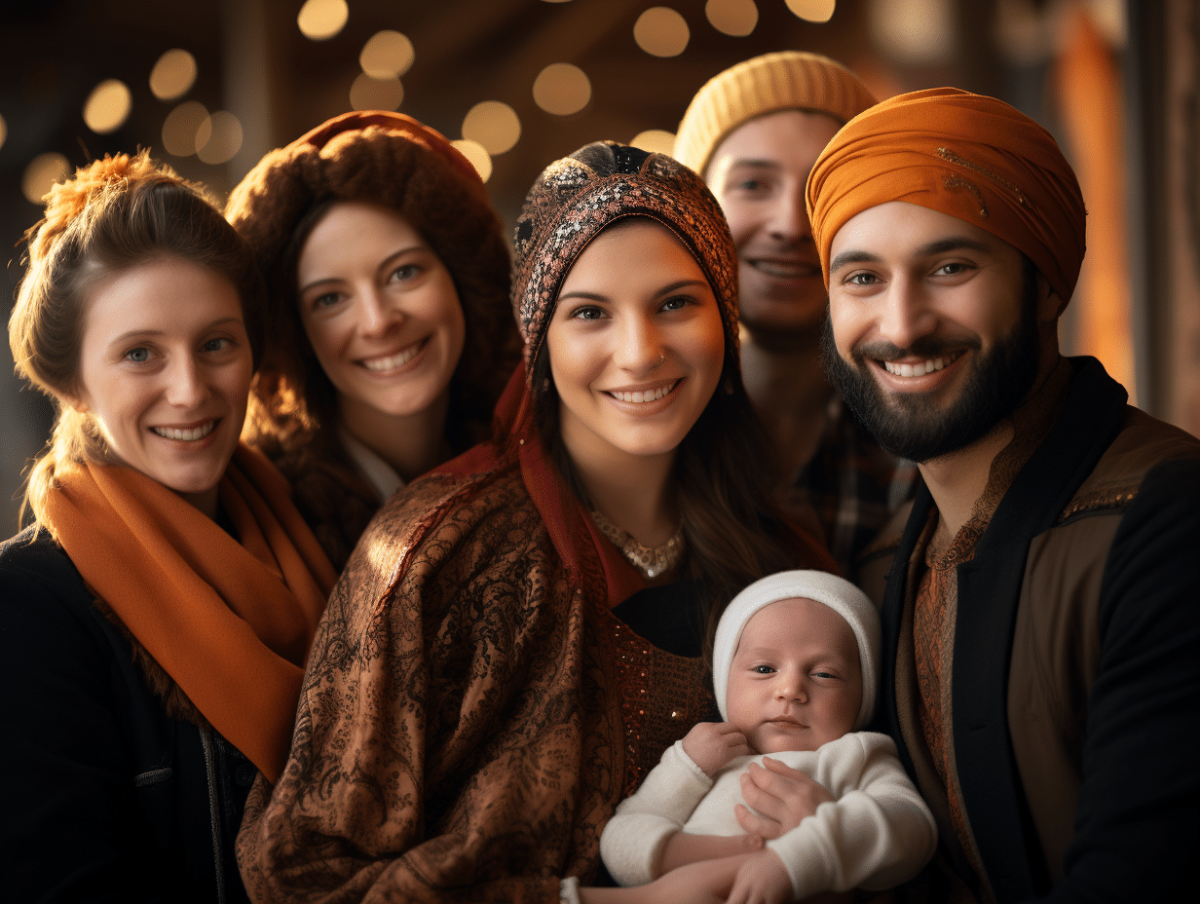
Throughout history, births have been celebrated around the world with a variety of rituals and traditions. These practices, often rooted in religious beliefs, are vibrant reflections of cultural diversity. They may include blessing ceremonies, rites of passage, or community festivals. Each culture offers a unique perspective on how to welcome new members into society. Exploring these traditions is a fascinating way to understand the values, hopes, and wishes that different communities around the world hold for their children from the moment they arrive in life.
Birth Rites Across Global Beliefs
In the excitement of birth celebrations, each religious tradition in the world offers a palette of nuances and customs. Within the Muslim community, the celebration of Mawlid ennabawi, also known as Aid al Mouled, Mawlid an Nabi, Milad an-Nabi, Mevlid Kandili, and Gamou, is celebrated with devotion. This festival, which honors the birth of the Prophet Muhammad, takes place on the twelfth day of Rabi al-awwal, the third month of the Islamic calendar. It is an opportunity for Muslim communities, whether Sunni or Shia, to express their love and respect for the Prophet and his family, the Ahl al-Bayt.
The spiritual dimension of birth is also manifested through specific rites unique to each culture. In the Jewish tradition, the Jewish baptism does not exist as such, but a set of rituals, such as Brit Milah and Zeved habat, are practiced to officially integrate the child into the community and celebrate their arrival. These practices, while deeply religious, are also moments of family and community gathering, where joy and blessings are shared.
In the Muslim context, practices vary significantly. Some groups consider Mawlid ennabawi to be a bid’ah, a blameworthy innovation, while others, such as the Fatimid dynasty, were pioneers of grand festivities in honor of the Prophet. The famous Muslim traveler and explorer, Ibn Battûta, even mentioned food distributions and public festivities during this celebration. These diversities illustrate the richness and complexity of cultural traditions related to birth.
The visit to the Kaaba, the holiest sanctuary in Islam located in Mecca, is also associated with religious festivities such as Mawlid ennabawi. This connection between a holy place and the celebration of a prophetic birth shows the intertwining of sacred spaces and life cycle events within Islamic culture. Festivals, celebrations, and birth celebrations offer an immersion into the cultural and spiritual heritage that transcends time and borders, revealing the universality of the phenomenon of birth and its anchoring in the sacred.

Meanings and Diversities of Celebration Practices
When delving into the cultural traditions of birth celebrations, it becomes evident that the diversity of practices reflects a multitude of meanings. In Islam, festivals such as Aïd el-Fitr and Aïd el-Adha are not only moments of joy and sharing but also expressions of gratitude to God for the blessings received. These canonical festivals, marking the end of Ramadan and the sacrifice of Abraham respectively, are examples of how rites of passage are integrated into the fabric of religious traditions. Practices vary from region to region, but all share a common foundation in sacred texts and prophetic teachings.
The notion of bid’ah, or religious innovation, plays a significant role in discussions about the legitimacy of celebrations such as Mawlid ennabawi. While some currents of Islam renounce these celebrations, deeming them inauthentic innovations, others fully embrace them, seeing them as expressions of piety and a reinforcement of faith. The Fatimid dynasty, for example, is known for having instituted some of the first grand celebrations of Mawlid, thus highlighting the evolution of practices over the centuries and Islam’s ability to incorporate diverse cultural elements.
The writings of Ibn Battûta, who observed the festivities of Mawlid ennabawi during his travels, provide a historical insight into these practices. His accounts detail food distributions, acts of generosity, and the festive atmosphere that permeated the streets. Such historical descriptions remind us that the celebration of birth has traversed the ages, adopting varied forms according to cultural and geographical contexts. The Kaaba, visited by pilgrims during many religious festivals, stands as a testament to the continuity of spiritual traditions and their intrinsic link to the rites of life.