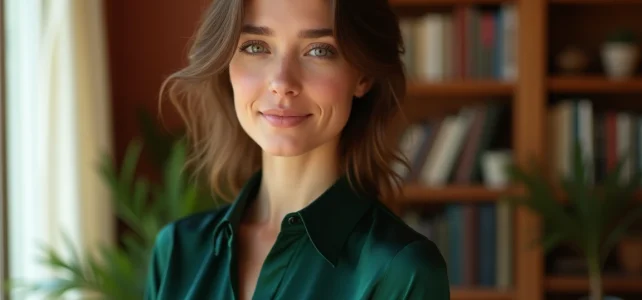
Hazel eyes change color depending on the light, shifting from olive green to golden brown in just a few seconds. Choosing clothing colors that enhance them is not just about consulting a list of flattering shades. The result mainly depends on the overall contrast between the skin, hair, and iris, a parameter that most color analysis guides overlook in favor of generic seasonal recommendations.
Natural contrast level and hazel eyes: the factor that classic colorimetry neglects
Seasonal colorimetry (spring, summer, autumn, winter) classifies individuals based on the temperature and clarity of their natural palette. This system works as a starting point, but it encounters a concrete problem: two people classified as “autumn” can have radically different contrast levels between their hair, skin, and hazel iris.
You may also like : How to Successfully Dress Your Staircase: Materials and Tips to Know
A woman with light brown hair, golden beige skin, and warm hazel eyes presents a soft contrast where everything blends into the same range. In contrast, very dark brown hair on light skin with the same hazel iris creates a strong contrast. The clothing colors that work for one may dull the other’s gaze.
The principle can be summarized as follows: the garment must reproduce or accentuate the natural contrast level of the face so that the hazel iris remains the focal point. A contrast that is too low between the top worn and the complexion “drowns” the gaze. A contrast that is too harsh diverts attention to the garment itself. Image professionals talk about contrast consistency, and this criterion refines choices well beyond the simple color wheel.
See also : How to Optimize Your Online Sports Viewing Experience?
Several resources detail the clothing colors for hazel eyes based on the temperature of the iris, which provides a good foundation to cross-reference with personal contrast levels.
Soft contrast: which clothing shades for a warm hazel iris
The typical case: Venetian blonde to medium brown hair, light to medium skin with golden undertones, hazel iris leaning towards amber brown or olive green. The entire face is situated within a tight tonal range, without sharp breaks.
Colors to favor for low contrast
The goal is to stay within medium shades that do not create a visual shock with the face. Warm hazel eyes stand out with soft yellows, coral, and apple green, according to recent analyses of personalized colorimetry. Bronze, apricot, and caramel also work because they extend the golden reflections of the iris without overwhelming them.
- Coral or apricot top worn near the face: the warmth of the fabric “activates” the golden sparkles of the hazel iris, whereas pure white would flatten everything
- Apple green or sage green in a blouse or scarf: these tones awaken the green component of the iris without forcing the contrast
- Bronze or caramel in knitwear: the gaze remains the brightest point of the face because the garment plays within the same tonal family, slightly darker
Conversely, a pure black or deep navy creates too harsh a break. The gaze gets lost between the saturated garment and the light skin. If black is essential (suit, event), a turtleneck in an intermediate tone (taupe, rosy brown) slipped between the black and the face restores the transition.
Medium and strong contrast: adapting the palette so the gaze dominates
Medium contrast: brown hair, medium skin, hazel iris
This profile offers the greatest latitude. The gap between the hair and skin is visible without being spectacular. Clothing shades can increase in saturation: terracotta, burgundy, forest green, and teal work well because they fit within the natural dynamics of the face.
Brown, which has become a reference neutral color in fashion and makeup in recent seasons, deserves special attention. On medium and warm complexions, a caramel or terracotta brown structures the upper body and highlights the hazel iris without hardening it, unlike black. Field feedback varies on this point for very light complexions, where a brown that is too warm can yellow the skin tone.
Strong contrast: very dark hair, light skin, hazel iris
This case is the most delicate. The face already presents a marked opposition, and the garment must maintain this energy without competing with it. Shades that are too soft (pastel, light beige) paradoxically erase the gaze because they break the contrast dynamic that the viewer’s eye naturally perceives.
The available data do not allow for a conclusion that a single palette works for all strong contrasts, but a few constants emerge:
- Deep burgundy and plum maintain the intensity of the contrast while directing attention to the warm reflections of the iris
- Emerald green or teal play a similar role: they offer enough depth to “hold” against the hair/skin contrast and enough warmth to engage with the hazel
- Off-white (ivory, ecru) advantageously replaces optical white, which hardens the contrast to the point of making the gaze secondary
For hazel irises with a cool dominance (gray-green reflections rather than golden), lavender, sky blue, and powder pink soften the gaze without dulling it. These cool shades mitigate the harshness that can be created by overly warm colors on an iris that lacks golden pigments.
Brown as a universal neutral for hazel eyes
The return of brown as a clothing base changes the game for hazel irises. Black, long considered the default neutral, tends to absorb light around the gaze and dull the subtle nuances of hazel. Brown, on the other hand, works as a discreet echo of the iris.
The shade of brown to choose depends on the skin undertone. On medium and warm complexions, a caramel or terracotta brown amplifies the golden reflections of the iris. On light skin, rosy or taupe browns avoid the “yellowed” effect. On dark skin, deep or metallic chocolate browns provide structure without competing with the natural brightness of the gaze.
A well-chosen brown blazer, worn with a top in one of the complementary shades described above (coral for soft contrasts, burgundy for strong contrasts), constitutes a combination that consistently brings the hazel iris to the forefront. The gaze becomes the anchor point of the face rather than a detail drowned in the outfit.
Choosing clothing colors based on one’s natural contrast rather than a generic colorimetry season requires a bit of observation in front of the mirror, but the result is immediately visible. The hazel iris, with its complex internal palette, responds to these adjustments more visibly than most other eye colors.