
On a nature-focused website, the volume of published content (species profiles, field articles, datasets, maps) makes conventional menu navigation inadequate once the site grows beyond a few dozen pages. The challenge is not finding the menu, but knowing which navigation tool to use for the type of resource you’re looking for.
Information architecture on a nature website: taxonomy versus tags
Most nature websites organize their content according to two overlapping systems. The first is a hierarchical taxonomy: parent categories (fauna, flora, habitats) divided into subcategories (mammals, birds, reptiles). The second is based on a system of cross-cutting tags (geographic area, conservation status, observation season).
Understanding this distinction changes the way you search. A taxonomy guides you down through the hierarchy. Tags let you combine criteria that the hierarchy keeps separate: for example, finding all protected species that can be observed in winter in a given area.
When a site offers both systems, the most effective approach is to start with the most specific category, then filter by tag. Starting with an overly broad tag (“biodiversity”) returns an unmanageable number of results. Conversely, consulting the Exp Nature sitemap gives you a complete overview of the site hierarchy and lets you identify the available categories in seconds, including those that don’t appear in the main menu.

Internal search engine: filtering options that are often underused
A nature website’s internal search engine doesn’t work like Google. It indexes only the site’s content, and its relevance depends directly on how well the publisher has tagged its pages.
Searching with multiple keywords
Entering a single generic term (“bird”) produces dozens of results, mixing species profiles, news articles, and PDF documents. Combining two or three specific terms cuts through the noise: “bird + breeding + wetland” targets a manageable subset.
Some nature platforms accept quotation marks to search for an exact phrase. Others don’t. A quick test using a phrase with and without quotation marks will show how sophisticated the search engine is.
Filters by content type
Well-structured sites offer sidebar filters after a search: document type (page, discussion, downloadable data), topic group, and publication date. These filters are the most underused tool. On the NaturAdapt platform, for example, filters let you limit results to a private group you belong to, excluding irrelevant public content.
- Filtering by format (PDF, map, field profile) separates downloadable resources from editorial content.
- Filtering by last updated date excludes outdated data, which is common on portals that have accumulated several years of publications.
- Filtering by group or category narrows the search to a coherent subject area.
Breadcrumbs and readable URLs: two overlooked navigation cues
The breadcrumb trail displays the current page’s place in the hierarchy. On a nature website, it shows the exact location in the site structure: Home > Fauna > Mammals > Bats. This cue lets you move up one level without going back to the menu and, more importantly, helps you understand how the site organizes its content.
The URL itself provides similar information when it’s structured in a readable way. An address such as site.fr/faune/mammiferes/chauve-souris immediately tells you which category the page belongs to. An opaque URL (site.fr/?p=4827) gives no clue about where the page sits in the hierarchy.
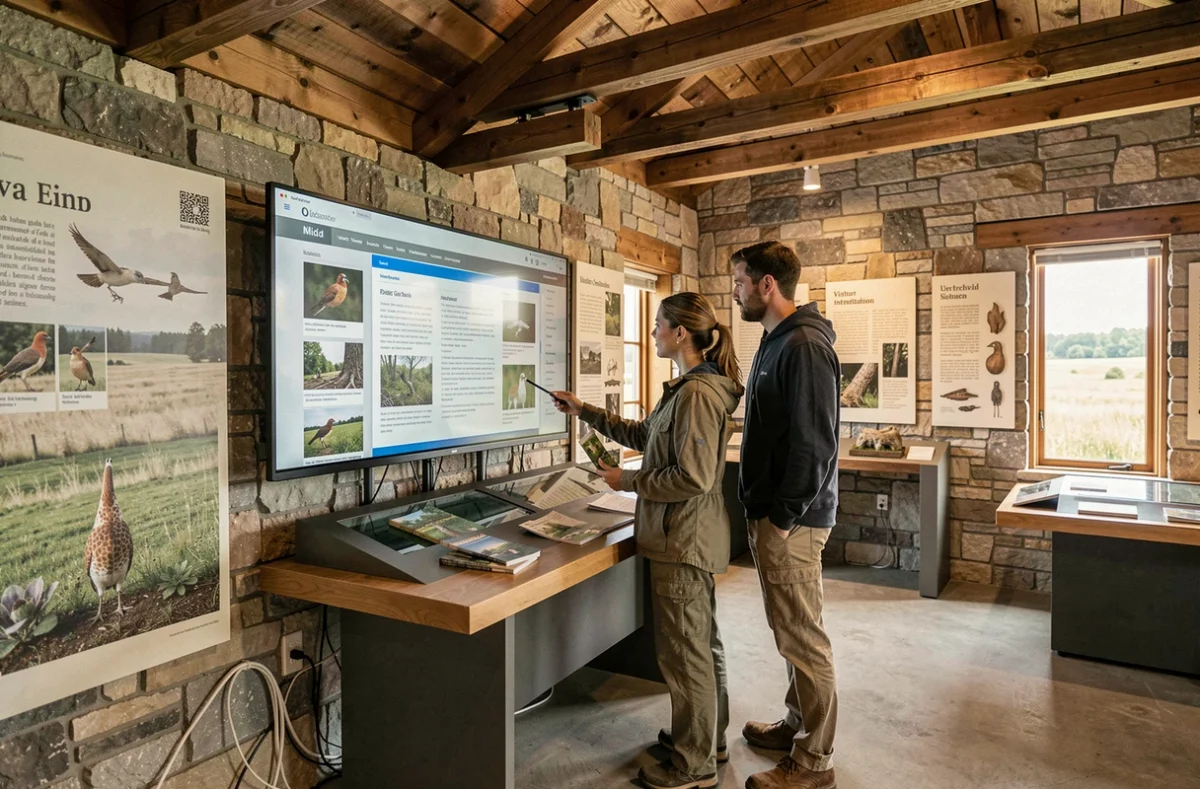
We recommend checking these two elements before exploring a site in depth. A site with a complete breadcrumb trail and readable URLs makes it easier to browse: you can edit the URL manually to move up to the parent category and discover related content.
Accessibility and keyboard navigation: a measure of website quality
Since June 28, 2025, the European Accessibility Act has covered certain consumer-facing digital services. For public websites or organizations subject to RGAA requirements, menus, links, and search tools must be keyboard-accessible and compatible with assistive technologies.
This regulatory framework has practical implications for all users, not just people with disabilities. A site that complies with RGAA structures its categories using semantic tags (nav, main, section), making navigation more predictable. Screen readers can interpret them, but so can browsers: mobile rendering, zoom behavior, and the readability of dropdown menus all depend directly on them.
A quick test is to navigate the main menu using the Tab key. If you can reach and activate every category without a mouse, the site meets a basic level of accessibility. If keyboard navigation skips items or traps focus in a submenu, the navigation architecture has technical shortcomings.
XML sitemap and HTML sitemap: two tools, two purposes
An XML sitemap is intended for indexing bots. It lists every URL on the site in a format that search engines can read, but people can’t.
An HTML sitemap, by contrast, is a browsable page that presents all categories and subcategories as clickable links. On a content-rich nature website, this page is the most reliable starting point for finding sections buried in the site hierarchy.
- An HTML sitemap reveals categories missing from the main menu (archives, databases, project pages).
- It lets you gauge the true size of the site before starting a targeted search.
- It serves as a fallback when the internal search engine’s filters aren’t precise enough.
Sites that provide an up-to-date HTML sitemap offer a practical advantage: you can be sure you won’t miss a resource just because it doesn’t appear in any menu or internal search result.
Exploring a nature website effectively comes down to three habits: check the site hierarchy using the HTML sitemap, use the internal search filters rather than relying on keywords alone, and use the breadcrumb trail to see where each page fits into the overall structure. Most nature platforms offer these tools, but most visitors overlook them.